The Challenge
With the endless number of movies available across multiple platforms, users often feel overwhelmed
and struggle to decide what to watch. This indecision, commonly known as choice
paralysis, causes
frustration and leads to wasted time and lower satisfaction.
As I explored this problem, I wanted to understand:
- Why do people struggle to pick a movie even when they already know their favorite genre?
- What factors influence how people decide which movie to watch?
- How can design help reduce the effects of choice paralysis without removing freedom of choice?
The Solution
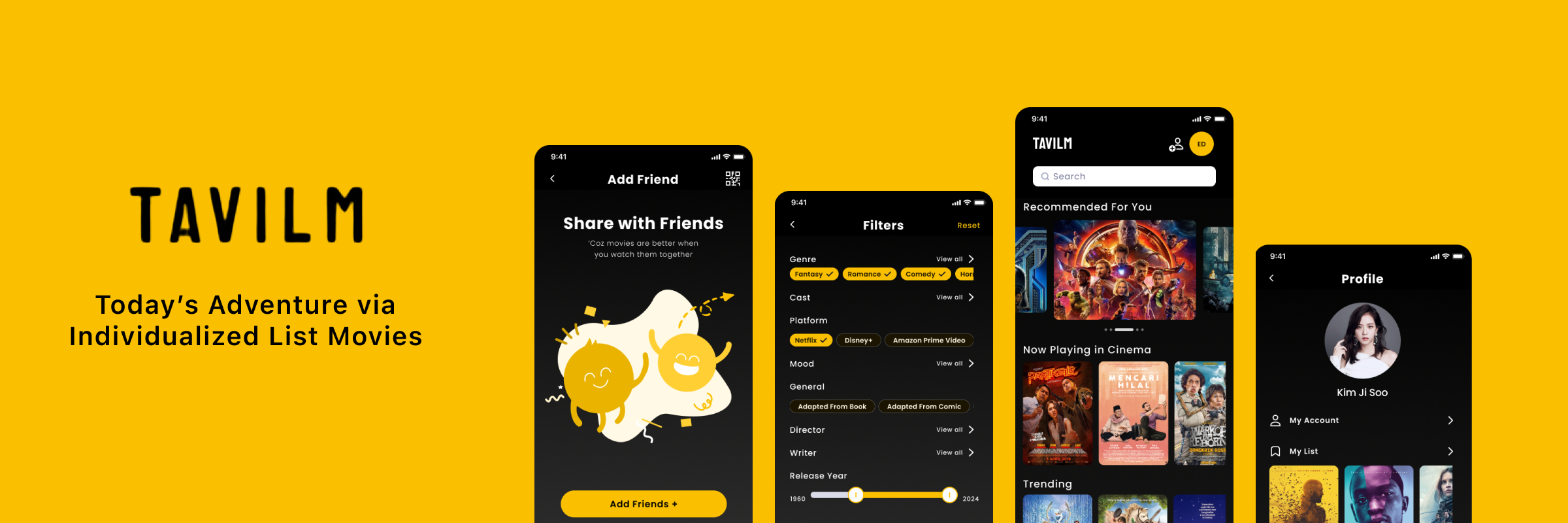
Tavilm is designed to reduce choice paralysis through a personalized, AI-powered
recommendation system that presents users with a curated range of films — just enough
to make
choosing easier without feeling limited.
Key features include:
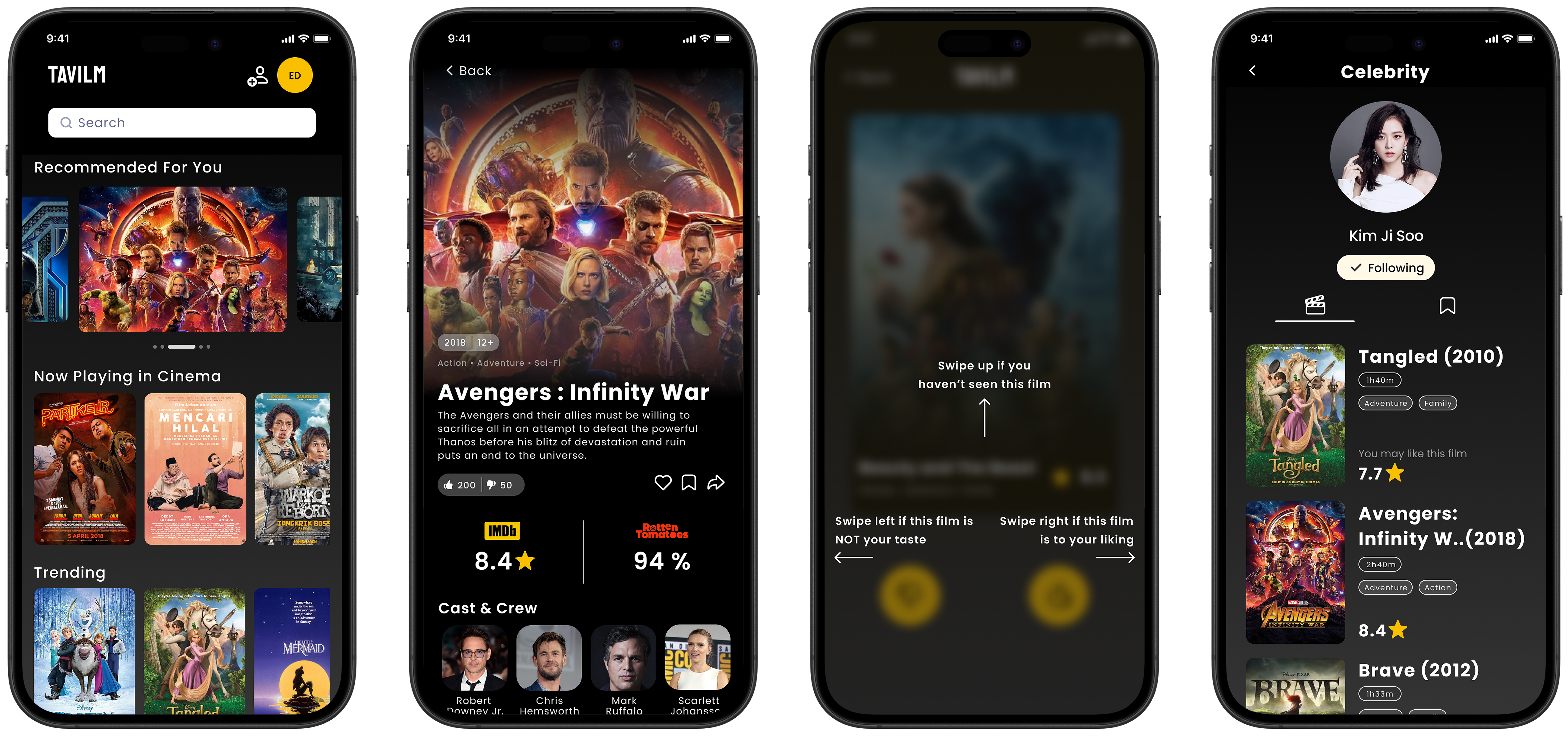
- Smart Curation: Recommends movies based on personal preferences like genre,
cast, and soundtrack.
- Movie Generator: Randomly suggests a curated list when users can’t decide what
to watch.
- Movie Tinder: Lets users swipe between films and receive more accurate
recommendations over time.
- Social Connection: Enables users to add friends, view what they’re watching,
and discuss movies.
Design Process
1. Discovering the Problem
After initial brainstorming, I identified the main challenge:
“
Which Movie Should I Watch?
”
To understand the root of this issue, I asked guiding questions such as:
- Why do people struggle to decide what movie to watch?
- What do they usually do before deciding?
- What internal and external factors influence their decision?
From here, I conducted desk research (via academic journals, articles,
and behavioral studies) and user interviews to understand how people make movie
choices and what makes them indecisive.
2. Research Findings
A. From Literature and Online Sources
- Too many options create choice paralysis — even when users already know their
preferred genre.
- Internal factors such as personal preferences (genre, actor/director,
soundtrack, perceived value, attention span, and personality) have the strongest influence.
- External factors such as ratings, reviews, word of mouth, critics, influencers,
social relevance, and platform availability also play significant roles.
- Before choosing a film, people often check trailers, posters, and reviews as
part of their decision-making ritual.
This revealed that choice paralysis isn’t caused by indecision alone — it’s also about
information overload and social validation.
B. From User Interviews
To verify these findings, I interviewed several users who regularly watch movies but
often struggle to pick one.
Key insights:
- Gen Z users are more prone to choice paralysis than Millennials, due to
naturally indecisive tendencies and social comparison behavior.
- Trailers have less influence than genre, actor, and reviews
when deciding what to watch.
- Many users experience FOMO (Fear of Missing Out) and tend to watch trending
movies to stay included in social conversations.
- Word of mouth has a major influence, with most users trusting friends’
recommendations over algorithms.
3. Deep Analysis and Synthesis
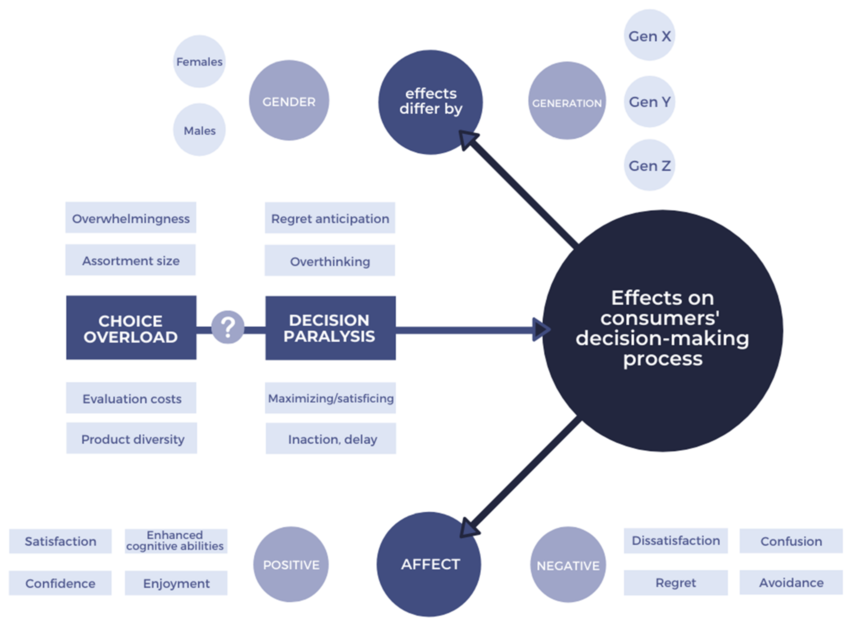
From both research and interviews, I mapped the causes and potential solutions to
choice paralysis:
- Internal Triggers: Personality, mood, and taste-based preferences.
- External Triggers: Ratings, reviews, word of mouth, and social pressure.
- Behavioral Pattern: Users seek reassurance before deciding — they look for
confirmation through trailers, reviews, or friends’ opinions.
Key Insight:
The main reason users struggle isn’t lack of options, but too many options
without meaningful differentiation.
According to Camerer’s study, the ideal number of options lies between
8–15, where users experience the highest satisfaction and least cognitive load.
Anything more increases hesitation and regret.too many options without meaningful
differentiation.
4. Defining the Design Direction
To reduce decision fatigue, I focused on implementing strategies such as:
- Limiting the number of visible options to the ideal range.
- Providing personalized curation that reflects both internal and external
influences.
- Simplifying comparison by emphasizing key information: genre, cast, and rating.
- Encouraging spontaneous decisions through features like Movie Tinder and Movie
Generator.
The goal was not to restrict freedom, but to curate clarity — helping
users reach confident decisions faster.
Visual Direction
The visual design of Tavilm embraces a cinematic yet modern
aesthetic to evoke
the atmosphere of exploring a theater — intimate, immersive, and intuitive. I used a
dark
background to emphasize film content while maintaining focus and reducing eye
strain during
browsing.
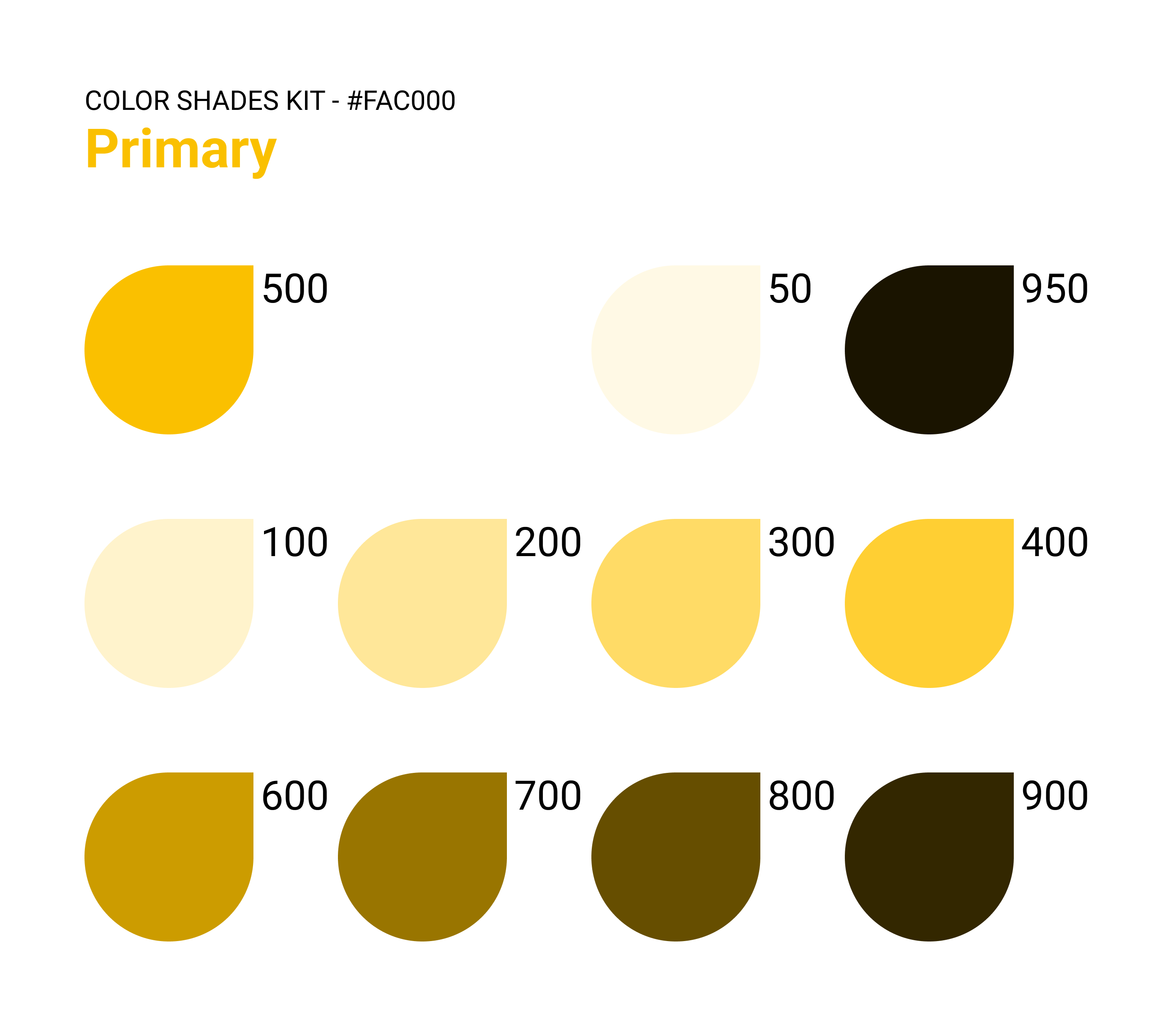
For the primary color, I used #FAC000, a vivid
yellow tone that symbolizes
warmth, energy, and excitement — reminiscent of cinema lights and the feeling of
anticipation before a movie starts. To maintain visual hierarchy and flexibility, I
developed a color scale ranging from 50 to 950, allowing
balanced contrasts between
highlights and darker UI elements.
The typography combines SF Pro for its legibility and neutral elegance,
creating a
modern and friendly tone that suits both light and dark interfaces. The use of ample
spacing,
rounded corners, and minimalistic iconography helps users focus on the content rather
than the
interface itself — reinforcing Tavilm’s goal to simplify decision-making.
The Outcome
Tavilm successfully redefined the movie discovery experience by turning indecision into
engagement. Through AI-driven curation, simplified choice presentation, and social integration,
users could find films faster, decide with confidence, and enjoy higher
satisfaction.
The project reinforced my belief that reducing friction in
decision-making is not about
removing options, but about guiding users through meaningful ones — an insight I continue to apply
in every design challenge.
Learning & Reflections
Through Tavilm, I learned how behavioral design and data-driven
insights can work
together to solve emotional challenges like choice paralysis. This project also taught me the
importance of balancing autonomy and algorithmic guidance, ensuring technology
empowers users rather
than overwhelms them.